Gold's Gym: What Happens When a 60-Year Legacy Meets Science-First Formulation
There’s a reason Gold’s Gym Venice Beach is called “The Mecca.” For six decades, it’s been the place where professional bodybuilders and first-time gym-goers train side by side - no hierarchy, no intimidation, just iron and intent. That culture doesn’t just make for a good brand story. For supplement formulators, it’s a genuine market signal.
The Gold’s Gym supplement line isn’t built to take share from the brands that already own the “aggressive pre-workout” category. It’s built to grow the total market, by reaching the consumers who’ve always been put off by it.
The question is how you translate 60 years of institutional trust into a product range that can actually deliver on it. The answer, according to Director of Product Innovation Kenny Carter, starts with one principle: full clinical dosing, every time.
Why Brand Trust Is a Formulation Decision
Most legacy brand extensions into supplements fail for the same reason: the brand carries the weight, and the product doesn’t. The consumer buys once on recognition and doesn’t come back because the product didn’t do what it implied.
Gold’s Gym is structuring its supplement line specifically to avoid that pattern. The target demographic isn’t the experienced athlete who cross-references ingredient labels. It’s the broader consumer who finds modern supplement branding - aggressive, overstimulated, cluttered with proprietary blends, actively alienating.
That audience trusts the Gold’s Gym name. But trust only converts to repeat purchase if the product actually works. Which is why the formulation philosophy starts from clinical evidence rather than cost-per-serving targets.
Full Clinical Dosing: The Podium Standard
Carter describes the formulation framework as a “gold, silver, and bronze” hierarchy. The goal is gold-level clinical values for every key ingredient in every product, not the minimum effective dose, not a partial inclusion dressed up with a trademarked blend name.
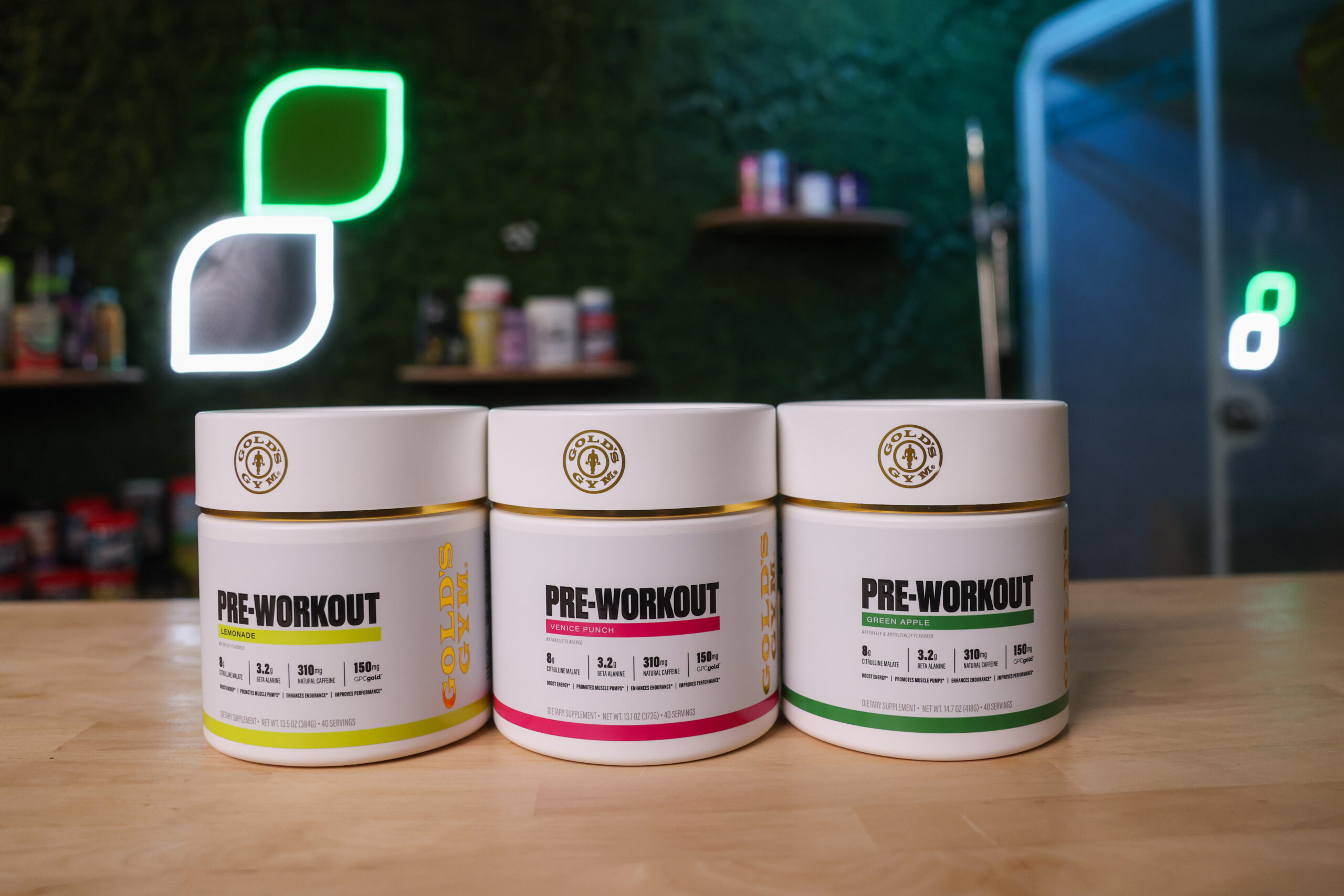
For the pre-workout specifically, that means:
Citrulline — 8g
Eight grams is the dose used in clinical research to meaningfully increase nitric oxide production, improve blood flow, and generate the muscular “pump” that signals genuine vasodilation. Many pre-workouts include citrulline at 3-4g and call it clinically dosed. At 8g, there’s no ambiguity.
Beta-Alanine — 3.2g
The established clinical dose for carnosine buffering and lactic acid threshold delay. This is the dose used in the studies that established beta-alanine as an endurance ingredient. Anything lower is a label claim that can’t be substantiated by the underlying research.
Natural Caffeine
Synthetic caffeine produces sharper peaks and harder crashes. Natural caffeine, sourced from green coffee, guarana, or tea, delivers a smoother energy curve. For a brand targeting consumers who find existing pre-workouts “too much,” the choice of caffeine form is a direct product-market fit decision, not just a formulation preference.
AstraGin®: The Ingredient Most Brands Miss
One of the more distinctive calls in the Gold’s Gym pre-workout formulation is the inclusion of AstraGin® — NuLiv Science’s patented absorption-enhancing ingredient, derived from Panax notoginseng and Astragalus membranaceus. In a category where brands obsess over hero ingredients, gut health and nutrient uptake rarely make the label.
The logic is straightforward: a pre-workout dosed at clinical values only works if those doses are actually absorbed. AstraGin® has been shown in multiple studies to enhance the intestinal uptake of amino acids, including citrulline, meaning the 8g dose has a better chance of doing what the research says it should.
For B2B buyers evaluating this kind of formulation, AstraGin® represents a category of thinking that separates science-led brands from label-first brands. It’s not the ingredient consumers search for. It’s the one that makes the ingredients they search for actually work.
Smart Stacking: Why Creatine Isn’t in the Pre-Workout
One of the more instructive formulation decisions in the Gold’s Gym range is what’s not in the pre-workout. Creatine is almost universally recognised as one of the most effective and evidence-backed performance ingredients available. It’s also a significant challenge to include at clinical doses in a pre-workout formula.
At 5g per serving, creatine inflates both the cost and the serving weight of any formula it’s added to. It also has well-documented texture issues in powder formats: the gritty mouthfeel that users report is a function of creatine monohydrate’s poor solubility. The answer isn’t to underdose it or obscure it in a blend. It’s to move it into a format where it can be delivered properly.
Creatine Gummies — 5g per Serving
The Gold’s Gym creatine gummy delivers the full 5g clinical dose in a format that sidesteps both the texture problem and the cost inflation of adding creatine to a powder. For consumers, it’s more convenient. For the pre-workout formula, removing creatine means the remaining ingredients can be dosed more aggressively without the cost and volume constraints.
The manufacturing challenge is real. Creatine is notoriously unstable in gummy formats without careful pH management. Carter highlights the need for pH-stable pectins and precise production timelines to prevent degradation before the product reaches the consumer. This is not a formulation shortcut. It’s a more technically demanding route, taken because the outcome is better.
Format Expansion: RTD, Snacks, and the ‘Ready to Consume’ Strategy
The supplement category is no longer synonymous with powders and capsules. The Gold’s Gym range reflects a clear move toward ready-to-consume (RTC) formats, including RTD (ready-to-drink) beverages and protein snacks, designed for consumers whose relationship with supplementation is more casual and convenience-driven.
This is consistent with broader market data. The RTD protein segment has grown substantially as consumers look for products that fit into existing routines rather than requiring preparation. A consumer who wouldn’t open a tub of pre-workout powder will pick up an RTD at a gym vending machine or an Amazon basket.
Distribution is also expanding beyond traditional specialty retail. The brand is launching through Amazon and TikTok Shop — two channels that reach categorically different audiences from the brick-and-mortar supplement aisle. TikTok Shop in particular is increasingly used by brands targeting 16–25-year-olds who discover products through content rather than retail browsing.

A Note on Younger Athletes and the ‘Less Is More’ Principle
Carter is explicit that despite the expanded reach into younger demographics, the brand maintains a conservative stance on supplementation for athletes aged 16–20. Today’s younger consumers have more access to research than any previous generation, but access to information isn’t the same as the context to apply it safely.
The “less is more” philosophy for younger users is both a brand integrity decision and a market one. A brand that earns the trust of a 17-year-old by recommending appropriate, measured supplementation retains that customer at 25, 35, and beyond. A brand that pushes high-stimulant stacks to the same consumer risks a very different long-term relationship.
FAQ
What makes Gold’s Gym supplements different from other pre-workout brands?
Most pre-workouts underdose key ingredients to keep costs down or to fit more ingredients on the label. Gold’s Gym formulates to full clinical values — the doses actually used in the research that established each ingredient’s efficacy — which is a significantly higher bar. The inclusion of AstraGin® for absorption support is also unusual in this category and reflects a more systems-level approach to formulation.
How much citrulline is actually in a clinical dose pre-workout?
The published research on citrulline and nitric oxide production consistently uses 6–8g. The Gold’s Gym pre-workout is dosed at 8g — the upper end of the clinically supported range. Many brands include 3–4g, which sits below the thresholds used in the efficacy studies, making “clinically dosed” claims difficult to substantiate.
Why is AstraGin in a pre-workout?
Most consumers don’t look for absorption enhancers on a supplement label. But if the active ingredients — citrulline, beta-alanine, amino acids — aren’t absorbed efficiently, the clinical dose on the label doesn’t translate into the physiological effect in the research. AstraGin® is included specifically to close that gap: it’s been shown to enhance intestinal uptake of amino acids, including citrulline, making the rest of the formula work harder.
Why is creatine sold separately instead of added to the pre-workout?
Creatine at 5g is a large, poorly soluble ingredient that adds cost, weight, and texture problems to any powder formula it’s included in. Moving it to a dedicated gummy format allows the pre-workout to be leaner and more affordable, while delivering creatine at the full clinical dose in a more palatable, convenient form. The gummy format requires more careful manufacturing — pH-stable pectins, tight production timelines, but the result is a better product on both sides of the stack.
Is Gold’s Gym targeting younger supplement users?
The brand is expanding into channels — TikTok Shop, Amazon, RTD formats, that reach younger demographics. But for users aged 16–20, the brand’s stated philosophy is “less is more.” This reflects both category responsibility and a longer-term customer retention logic: a brand that advises appropriate supplementation for younger athletes earns a more durable relationship than one that sells aggressively to that demographic.
What does ‘ready to consume’ mean in the supplement context?
Ready-to-consume (RTC) formats include any product that doesn’t require measuring, mixing, or preparation — RTD beverages, protein snacks, gummies. These formats serve consumers whose engagement with supplements is more casual or on-the-go, and they open the category to people who won’t buy a powder but will pick up a drink or a bar. It’s a meaningful distribution and market expansion move, not just a packaging change.
Build Smarter. Dose Right. Back Every Claim.
NuLiv Science supplies AstraGin® and other clinically supported ingredients to supplement brands that formulate to perform. If you’re developing a product that needs to do more than look good on a label, talk to the NuLiv Science team or request a sample.
References
Pérez-Guisado, J., & Jakeman, P. M. (2010). Citrulline malate enhances athletic anaerobic performance and relieves muscle soreness. Journal of Strength and Conditioning Research
Hobson, R. M. et al. (2012). Effects of β-alanine supplementation on exercise performance: a meta-analysis. Amino Acids
Rawson, E. S., & Volek, J. S. (2003). Effects of creatine supplementation and resistance training on muscle strength and weightlifting performance. Journal of Strength and Conditioning Research
AstraGin® ingredient overview and clinical data. NuLiv Science
This product is not intended to diagnose, treat, cure, or prevent any disease. This content is intended for B2B supplement industry audiences.
.png)


.jpg)
.jpg)
.jpg)