





We believe performance and recovery aren’t just for the young. And now, the science is catching up.
Most sports nutrition ingredients have been studied in healthy young men. That’s the reality. So when new human clinical research focuses specifically on exercising older women, it’s worth paying attention.
Published in the Journal of Ginseng Research, this new trial is Senactiv®’s first clinical study focused exclusively on women, postmenopausal women aged 60–73, specifically. Here’s what it found, and why it matters for brands building in the active aging and women’s health spaces.
The Opportunity: Women’s Recovery Is a Whitespace in Sports Nutrition
Women’s health is one of the fastest-growing categories in supplements right now. But there’s still a significant gap when it comes to recovery, especially for women over 60.
After menopause, the body’s response to exercise changes. Muscle signalling shifts. Energy production in muscle cells slows. Recovery takes longer. Yet the vast majority of recovery-focused ingredients on the market were never tested in this population at all.
Brands that can fill that gap, with real, life-stage-specific clinical evidence, are ahead of the curve. Senactiv® now has exactly that.
What Is Senactiv?
Senactiv® is a patented ingredient from NuLiv Science, made from highly purified extracts of Panax notoginseng and Rosa roxburghii. Its key active compound is ginsenoside Rg1.
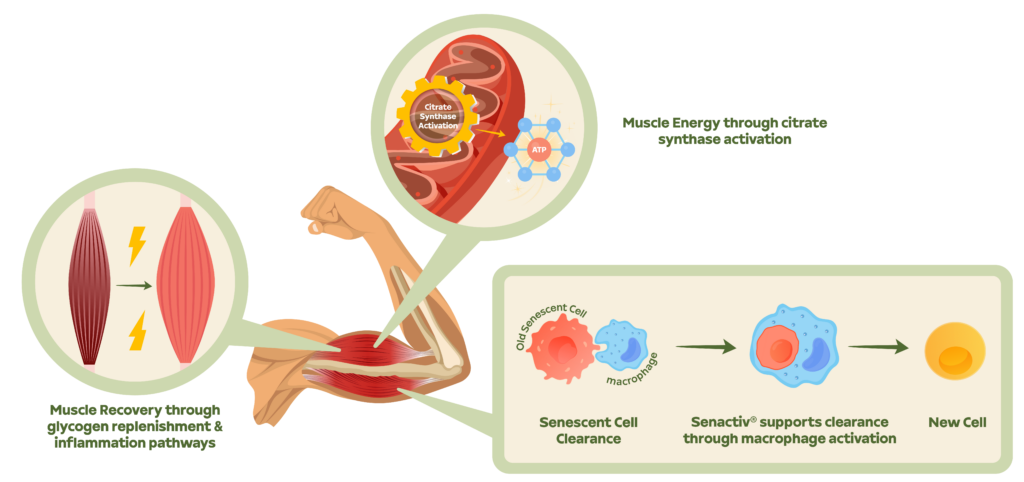
It’s one of the market’s first senolytic ingredients developed specifically for exercise. What does that mean? It works by helping to clear away aged, dysfunctional muscle cells, making room for fresher, more energetic ones to take their place. The result is better mitochondrial function, improved recovery, and more consistent performance over time.
Senactiv® is the product of more than 10 years of R&D and has been used in six human clinical studies. The emphasis throughout has been on exercise performance, especially muscle energy, recovery, and cellular regeneration.
The New Study: Breaking Down the Research
Study Design
Randomised. Double-blind. Placebo-controlled. Crossover design with a three-week washout between conditions. This is as rigorous as supplement research gets; each participant served as her own control, which makes the findings more reliable.
Who Was Studied
Eleven sedentary postmenopausal women, aged 60–73, with no regular exercise habit (less than once per week). Participants taking insulin, sex hormones, or anti-inflammatory medications were excluded, keeping the data clean.
The Protocol
- 100 mg Senactiv® (providing 10 mg ginsenoside Rg1), taken one hour before exercise
- Exercise: 4 sets × 10 reps of seated leg press at 70% of one-repetition maximum
- Muscle biopsies at baseline, immediately post-exercise, and at 24 hours post-exercise
Those biopsies are significant. Rather than relying on blood markers or self-reported soreness, researchers were measuring what was actually happening inside muscle tissue. That’s a much higher bar and Senactiv® cleared it.
What the Research Found
The headline finding: a significant increase in mitochondrial content in skeletal muscle after exercise in the Senactiv® group compared to placebo.
Mitochondria are the power generators of muscle cells. More mitochondrial content during recovery means more capacity to produce cellular energy, which directly affects how well and how quickly muscle can repair itself after training.
Additional findings included:
- Differences in markers related to the post-exercise recovery response in muscle tissue
- Changes in cellular activity markers linked to biological recovery signals after resistance exercise


Put simply: Senactiv® helped support the body’s own repair systems after exercise, the cells and cellular energy machinery that matter most for recovery, in women aged 60 and over.
Full statistical data is available in the published study. See References below.

Why Mitochondria Matter for Women Over 60
Here’s something most supplement brands overlook: mitochondrial function in muscle declines with age, and that decline accelerates after menopause. Lower oestrogen levels affect the body’s ability to produce and maintain mitochondria in muscle, which is a key reason why recovery gets harder as women get older.
An ingredient that supports mitochondrial content during post-exercise recovery in older women isn’t making a vague wellness claim. It’s addressing one of the core physiological challenges of the postmenopausal active demographic, with biopsy-level evidence to back it up.
For brands, that translates into a genuinely differentiated claim; one your target consumer can feel, and one you can substantiate.
How This Study Builds on Senactiv®’s Existing Research
This isn’t Senactiv®’s first rodeo. The ingredient already has a strong evidence base from studies in younger male athletes. Earlier research showed:
- Reduced perceived exertion during resistance exercise
- Lowered senescent cell markers (p16INK4a mRNA, beta-galactosidase) from biopsied muscle
- Improved inflammatory balance during exercise
- Supported endothelial progenitor cell activity after exercise
What makes this new study significant is the population. Older, sedentary, postmenopausal women are almost never included in sports nutrition research. This trial demonstrates that Senactiv®’s effects aren’t limited to elite athletes or younger demographics. To explore the full clinical portfolio, visit the Senactiv® ingredient page.
Where Senactiv® Fits in the 2026 Market
The timing of this research couldn’t be better. Four converging trends are shaping where the supplement industry is heading:
- Women’s health innovation is accelerating – consumers want products built for their life stage, not adapted from formulas designed for men
- Active aging is a defining growth category – longevity-focused brands need clinical credibility, not just antioxidant claims
- Muscle health is a healthspan conversation now – women are seeking science-backed support for muscle function, not just aesthetics
- Demographic-matched data is the new baseline – generic clinical evidence no longer cuts through
Senactiv® sits at the centre of all four.
Ready to Formulate with Senactiv®?
Whether you’re building a recovery product for active older women, an active aging sports nutrition line, or a women’s health formula that needs real clinical muscle, Senactiv® gives you the ingredient and the evidence to back your claims.
Explore formulation guidance, dosing, and the full clinical dossier on the NuLiv Science website, or get in touch with our team directly.
Train. Recover. Adapt. At every stage of life.
Frequently Asked Questions
What does Senactiv actually do in the body after exercise?
Senactiv® helps the body remove senescent (aged, dysfunctional) cells from active skeletal muscle, making room for new healthy cells to regenerate. In clinical research, it’s been linked to increased mitochondrial content during post-exercise recovery, better inflammatory balance in exercised muscle, and enhanced activity of endothelial progenitor cells, which play a key role in muscle repair.
Is there a clinical study on Senactiv for women specifically?
Yes, and it’s the first of its kind for this ingredient. A 2026 randomised, double-blind, placebo-controlled crossover trial tested Senactiv® in postmenopausal women aged 60–73 following resistance exercise. The strongest finding was a significant increase in skeletal muscle mitochondrial content in the Senactiv® group vs. placebo, measured directly via muscle biopsy.
Why do women over 60 recover more slowly from exercise, and can a supplement help?
After menopause, declining oestrogen is associated with reduced mitochondrial function in muscle, slower cellular regeneration, and a blunted recovery response to exercise. It’s why many older women find it harder to bounce back between sessions. Senactiv® is the first senolytic ingredient with clinical data in this specific demographic, showing support for mitochondrial content and recovery-related cellular markers after resistance exercise in women aged 60–73.
What supplement ingredients have women’s health clinical data for muscle recovery?
Honestly, not many. Most sports nutrition ingredients have only been studied in younger healthy men. Senactiv® (ginsenoside Rg1 from NuLiv Science) now has a dedicated human clinical study in postmenopausal women, making it one of the few recovery-focused ingredients with life-stage-specific evidence. Creatine and collagen peptides have some women-focused data in adjacent areas, but neither targets the senolytic or mitochondrial recovery mechanism that Senactiv® addresses.
Does Senactiv have clinical data beyond just one study?
Yes. Senactiv® is backed by more than 10 years of R&D and six human clinical studies. Prior research in young healthy men showed reduced perceived exertion, reduction of senescent cell markers from biopsied post-exercise muscle, improved inflammatory balance during exercise, and enhanced endothelial progenitor cell activity post-exercise. The 2026 postmenopausal women’s study is the latest addition to that growing body of evidence.
What should I look for when formulating a recovery supplement for active women over 60?
Look for ingredients with demographic-matched clinical data, not just broad recovery claims. Key mechanisms to target: mitochondrial support, senescent cell clearance, and inflammatory balance in muscle tissue. Senactiv® covers all three and it’s now one of the only senolytic ingredients with a clinical study specifically in postmenopausal women. It’s commonly co-formulated with AstraGin® for enhanced absorption. Clinically dosed at 50-100 mg, and a 35 mg Novel Food recommended dosage.
References
Senactiv® ingredient profile: NuLiv Science — Senactiv®
Prior human study (trained healthy men): Reduced stem cell aging in exercised human skeletal muscle is enhanced by ginsenoside Rg1 — Aging, 2021
*These statements have not been evaluated by the Food and Drug Administration. This product is not intended to diagnose, treat, cure, or prevent any disease. This content is intended for B2B supplement industry audiences.