JointIQ® Now Has a Published Human Trial
Pick up almost any botanical joint ingredient and you will hear a familiar story. An ancient plant. A long history of traditional use. Some promising results in the lab.
Those are solid foundations. But many botanical joint ingredients can only point to traditional use and lab studies, and the story stops there.
JointIQ® can point to both, plus a published human trial.

In its first human clinical trial, active adults took one small 200 mg capsule a day for 12 weeks. By the end, they said their knees got in the way of everyday life a lot less. They could also straighten their knees further than people who took a dummy pill. The study was run independently by university researchers in Taiwan and published in the peer-reviewed journal Nutrients.
"We've built around Astragalus membranaceus for 25 years on traditional use and cell research," says Richard Wang, CEO of NuLiv Science. "Now we have the human data to back our previous studies, and everything moved in the same direction."
The short version
- The first human trial on JointIQ®, a patented, plant-based ingredient from astragalus root
- 50 healthy, active adults with everyday knee discomfort and no diagnosed knee condition
- One 200 mg capsule a day for 12 weeks, compared with a placebo
- Gold-standard design: randomized, double-blind and placebo-controlled
- Headline result: knee-related quality of life improved by about 11.7 points more than placebo
- Second result: people could straighten their knees about 6.5° further than the placebo group
Meet the ingredient: what is JointIQ®?
JointIQ® starts life as the root of Astragalus membranaceus, a plant that has been part of Traditional Chinese Medicine for centuries. NuLiv Science takes that root and pulls out a purified group of natural compounds called saponins. The result is a fine powder that does its job at just 200 mg.
It also ticks the boxes product developers care about. It is patented (US Patent 8,168,596 B2), Halal and Kosher certified, plant-based and small enough to slip into almost any format.
Why knees?
Think about how much your knees do in a day. Stairs. School runs. Gym sessions. Weekend hikes. Inside each knee, a smooth, rubbery layer called cartilage lets the bones glide instead of grind.
Plenty of active adults start to feel their knees long before any doctor gives it a name. A twinge on the stairs. Stiffness after a run. And when knees complain, people quietly start moving less. That is the moment this study set out to explore.
Inside the trial
The study took place at Chung Shan Medical University in Taiwan. Here is the part that matters for anyone weighing up the evidence: the university paid for it. NuLiv Science supplied the capsules and stepped back. The researchers reported no conflicts of interest, and they registered the trial publicly on ClinicalTrials.gov (NCT07382622) before it began.
Fifty adults signed up. They were active, healthy and mostly in their 40s, and they all had one thing in common: knees that grumbled during activity. Nobody had a diagnosed condition, recent knee surgery or other joint disease. Forty-eight made it to the finish line.
The design was as fair a test as science allows:
- Randomized: a computer split people into two groups, like a coin toss
- Double-blind: neither the volunteers nor the researchers knew who got what until the end
- Placebo-controlled: half took JointIQ®, half took an identical-looking capsule with nothing active in it
Every morning after breakfast, each person took one capsule. Twelve weeks later, the researchers put their knees through their paces again:
- The single-leg step-down test. Stand on a box on one leg and lower yourself down slowly. It sounds easy. It is a tough test of how well a knee controls movement.
- Range of motion. How far the knee could bend and straighten.
- The KOOS questionnaire. A trusted knee survey used in research since 1998. It scores pain, symptoms, daily activities, sport and recreation, and quality of life from 0 to 100.
- Blood tests. A first look at markers linked to joint and cartilage health.
The results: knees that felt and moved better
The standout finding was not a lab number. It was how people felt about their knees in everyday life, and that is the result that matters most to the people buying joint supplements.

The quality of life result is the one to remember. It was the only result to hold up after the researchers ran a stricter statistical check across all their comparisons, and it cleared the bar researchers use for a change people would actually notice.
Quick science lesson: what is a p-value? It is a measure of how likely it is that a result happened by luck. The smaller the number, the less likely luck explains it. Scientists usually look for anything under 0.05. A p-value of 0.003 is well under that line.
Progress from where they started
The JointIQ® group also improved on almost everything compared with their own starting point. The placebo group did not. These gains did not beat placebo head to head, so they are supporting evidence, but the direction is hard to ignore:
- Step-down test scores rose by about 20%
- Recovery time after the test fell by more than a third (33%)
- Every KOOS area improved, led by sport and recreation (up 22.23%) and quality of life (up 18.38%)
Put simply: after 12 weeks, people taking JointIQ® moved better, bounced back faster and felt better about their knees, both on the sofa and on the sports field.
A first peek under the hood
The blood tests offered an intriguing clue, with one big caveat attached.
Inside the JointIQ® group, markers linked to joint stress and cartilage wear (IL-8, COMP and MMP-13) went down. Meanwhile PIINP, a marker linked to building new cartilage, went up.
That is exactly the pattern NuLiv Science saw years earlier in the lab. Those cell studies found JointIQ® supported collagen II (a key building block of cartilage), hyaluronic acid and glucosamine uptake, while helping to lower MMP enzymes, which break cartilage down.
Now the caveat. These blood results were exploratory, a first look rather than the main event. When the researchers compared them with placebo using a stricter statistical test, the differences did not hold up. So think of them as a hint about how JointIQ® might work, not as a finished answer. More research will tell the rest of the story.
Why this lands at exactly the right moment
Joint health used to be something people worried about in their 70s. Not anymore. Today's 40-somethings are lifting weights, running half marathons and doing Pilates, and they want their knees to keep up for decades. That shift is reshaping the whole category.
The market is big, and getting bigger
The global bone and joint health supplement market is worth around USD 16.5 billion in 2026 and could more than double to USD 35 billion by 2036, according to Fact.MR. Joint health is the biggest slice of that pie, at about 34%.
The new joint shopper is active, not retired
Sports recovery is the fastest-growing corner of the category, as joint support becomes part of everyday fitness routines. Analysts at Lucintel also flag active adults and athletes as a major growth group. That is precisely who took part in the JointIQ® trial.
Quality of life is the new headline benefit
Consumers increasingly care about long-term mobility, flexibility and simply feeling good, reports FMCG Gurus in its 2026 joint health research. Which makes the timing rather neat: knee-related quality of life was JointIQ®'s strongest result.
Shoppers want plants, and proof
People want short, recognisable ingredient lists. They are also more sceptical than ever about bold claims. A plant-based ingredient with an independent, published human trial answers both of those wishes at once.
Goodbye horse pills, hello gummies
Joint support is breaking out of chunky tablets and into gummies, drinks, powders and snack bars. At 200 mg, JointIQ® is small enough to fit in without hijacking the taste or texture.
What this means for your next formula
For brands in joint, mobility, sports or healthy-aging, the pitch writes itself. Many botanical joint ingredients can only point to traditional use and lab studies. JointIQ® can point to both, plus a published human trial, with its best result landing on the outcome your customers care about most.
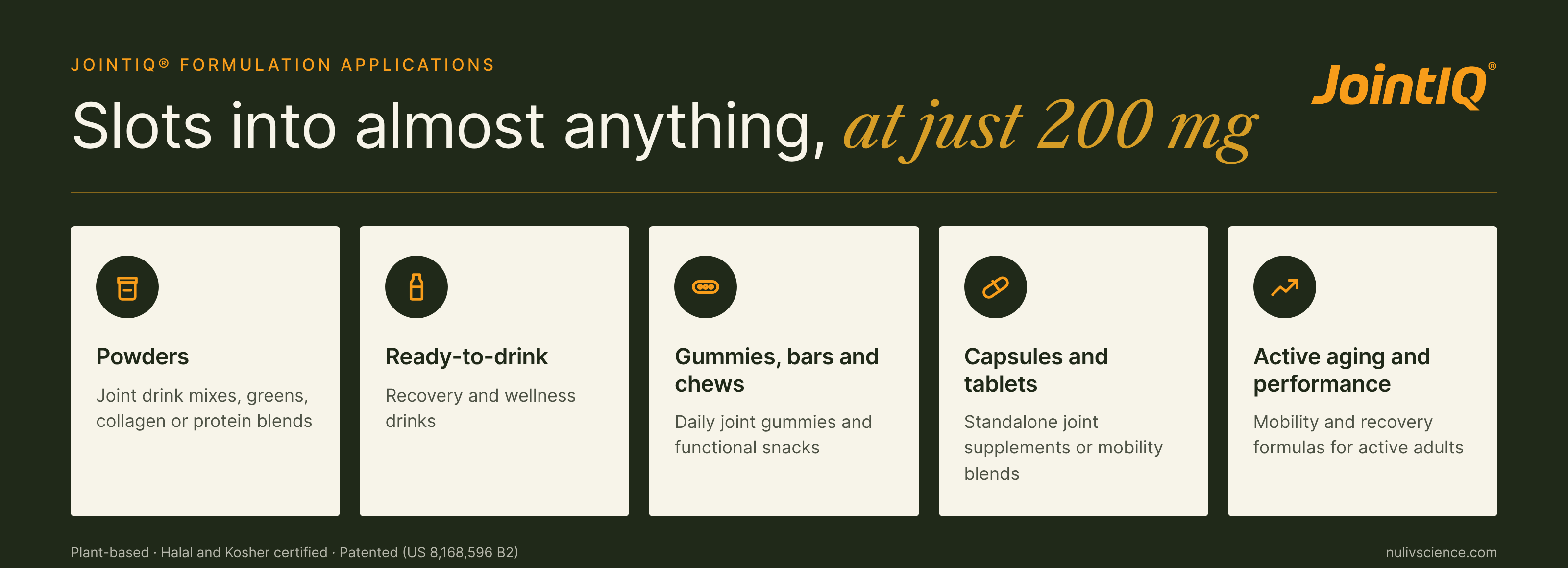
On your label (check with your regulatory team first): JointIQ® is clinically studied, helps support joint comfort, supports knee-related quality of life and everyday movement, and offers plant-based joint support for active adults.
Ready to take a closer look?
- Get the full story in the JointIQ® Executive Brief
- Explore the JointIQ® ingredient page
- See how AstraGin® can sit alongside JointIQ® in performance formulas
- Talk to the NuLiv Science team about samples, study references and formulation support
FAQs
Does JointIQ® actually work in people, or just in the lab? Both, now. In a 12-week trial of 50 active adults, those taking 200 mg of JointIQ® a day reported better knee-related quality of life and better knee straightening than those on a placebo.
How long did it take people to notice a difference? The researchers measured results after 12 weeks of daily use. They did not check in between, so 12 weeks is the timeframe the study supports.
How much JointIQ® was used in the study? One 200 mg capsule a day, taken after breakfast. That small dose makes it easy to add to gummies, powders, drinks and capsules.
Who was JointIQ® studied in? Healthy, active adults with an average age in their mid-40s who felt knee discomfort during activity. Nobody in the study had a diagnosed joint condition.
Is JointIQ® the same as astragalus supplements I see in shops? Not quite. Generic astragalus is the whole root. JointIQ® is a patented, purified saponin compound taken from it. Its results come from its own lab studies and its own human trial, so they apply to JointIQ® specifically.
Who ran the study, and can I trust it? Researchers at Chung Shan Medical University in Taiwan ran it, and the university funded it. It was registered on ClinicalTrials.gov (NCT07382622), published in the peer-reviewed journal Nutrients and the authors reported no conflicts of interest.
Can my brand say JointIQ® is clinically proven? No. The accurate (and compliant) wording is "clinically studied." You can say it helps support joint comfort and knee-related quality of life in active adults.
Where can I get samples or the full study? Email sales@nulivusa.com or get in touch with NuLiv Science.
References
- Evaluation of the Effect of Astragalus membranaceus Saponins Administration on Knee Function and Cartilage Biomarkers in Healthy Subjects with Knee Discomfort. Nutrients 2026, 18, 1842.
- Effect of JointIQ on Joint Discomfort in Healthy Subjects. ClinicalTrials.gov, NCT07382622
- Roos EM, Lohmander LS. The Knee injury and Osteoarthritis Outcome Score (KOOS): from joint injury to osteoarthritis. Health and Quality of Life Outcomes, 2003. Read the paper
- Fact.MR. Global Bone and Joint Health Supplement Market to Reach USD 35.0 Billion by 2036. July 2026. Read the release
- Lucintel. Joint Supplement Market Report: Trends, Forecast and Competitive Analysis to 2031. View report
- FMCG Gurus. Joint Health in 2026: Global Report. View report
These statements have not been evaluated by the Food and Drug Administration. JointIQ® is a dietary ingredient and is not intended to diagnose, treat, cure, or prevent any disease.